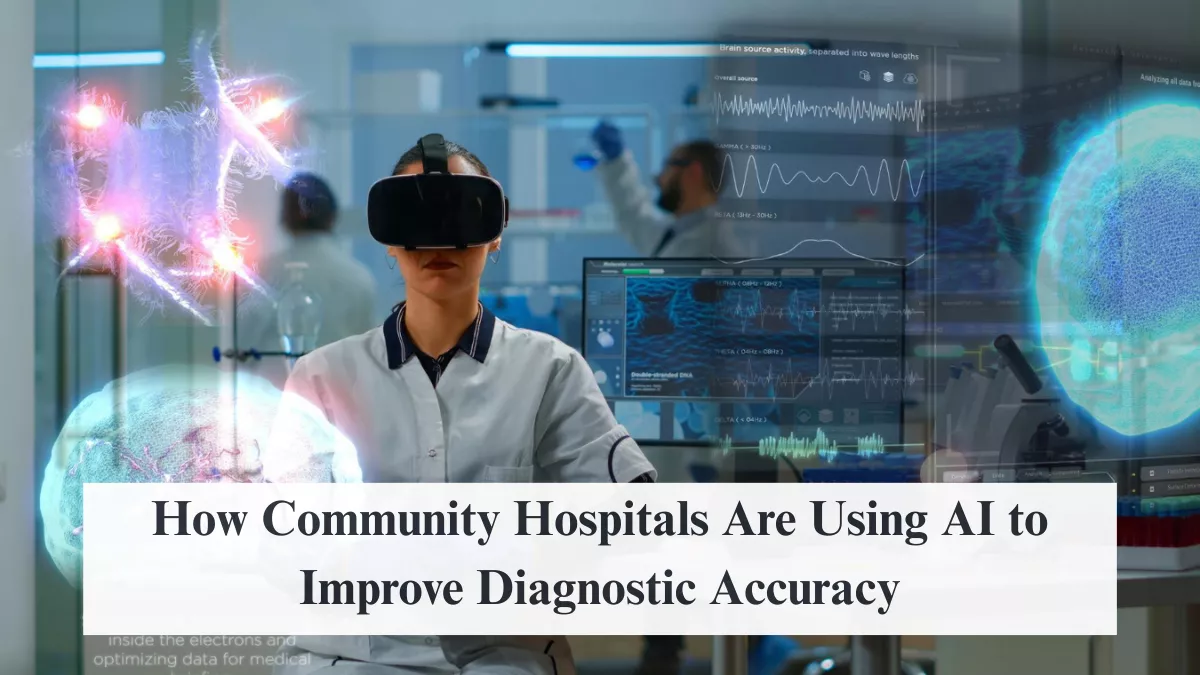
Artificial intelligence (AI) is revolutionizing healthcare by offering tools that enhance diagnostic accuracy, streamline workflows, and improve patient outcomes. Community hospitals, which often serve diverse populations with limited resources, are increasingly adopting AI-driven solutions to support clinical decision-making. By analyzing large volumes of medical data, detecting patterns, and providing predictive insights, AI assists healthcare professionals in identifying diseases earlier and more accurately. The integration of AI in diagnostics helps reduce human error, accelerates the diagnostic process, and ensures that patients receive timely, effective treatment.
Understanding AI and Its Applications in Diagnostics
AI encompasses machine learning, deep learning, natural language processing, and computer vision technologies. In diagnostics, AI systems can analyze medical images, lab results, electronic health records (EHRs), and patient-reported data. Applications include:
 The Role of Local Medical Centers in Promoting Heart Health Awareness
- Radiology: AI interprets X-rays, CT scans, and MRIs.
- Pathology: AI detects anomalies in tissue samples.
- Cardiology: AI evaluates ECGs and echocardiograms.
- Laboratory Diagnostics: AI analyzes blood work, urine tests, and other biomarkers.
By leveraging these technologies, community hospitals can enhance diagnostic accuracy, reduce delays, and optimize treatment planning.
Enhancing Radiology Accuracy Through AI
Radiology is one of the primary areas where AI demonstrates significant impact. AI algorithms can identify abnormalities in imaging studies that might be missed by human eyes, such as small tumors, fractures, or subtle lung lesions. In community hospitals with limited radiologists, AI provides an additional layer of review, reducing diagnostic errors and improving patient outcomes. AI-assisted radiology enhances efficiency by prioritizing critical cases and streamlining workflow, ensuring that patients with urgent conditions receive timely attention.
Pathology and AI-Assisted Analysis
AI supports pathologists by analyzing tissue samples, identifying patterns indicative of diseases, and quantifying cellular abnormalities. Automated analysis reduces subjectivity and interobserver variability, providing consistent, accurate results. In community hospitals, AI-assisted pathology allows faster turnaround times for biopsy reports and ensures accurate detection of conditions such as cancer, infections, and autoimmune disorders. Combining human expertise with AI enhances diagnostic reliability and improves patient confidence in treatment plans.
 How Mobile Clinics Are Expanding Healthcare Access in Underserved Areas
Cardiology and Predictive Analytics
AI is transforming cardiology by providing predictive analytics for early detection of heart disease. Machine learning algorithms analyze ECG data, heart rate variability, and imaging studies to identify patients at risk for arrhythmias, heart attacks, or heart failure. Community hospitals use AI tools to triage high-risk patients, optimize treatment strategies, and reduce readmission rates. Early detection through AI-driven analytics enhances preventive care and improves long-term cardiac outcomes.
Laboratory Diagnostics and AI
Laboratory tests generate vast amounts of data that can be complex to interpret. AI platforms can analyze trends, detect anomalies, and flag abnormal results for further review. In community hospitals, AI-supported lab diagnostics reduce errors in blood counts, chemistry panels, and microbiology tests. Faster, accurate interpretations lead to timely interventions, preventing complications and improving patient safety. AI also supports the identification of rare diseases by recognizing patterns that may be overlooked in traditional analyses.
 Why Hospital-Based Exercise Programs Improve Patient Recovery Rates
Electronic Health Records (EHR) Integration
Community hospitals utilize AI to analyze electronic health records for enhanced diagnostic accuracy. AI systems can review patient history, previous test results, medication records, and clinical notes to detect risk factors and suggest potential diagnoses. Natural language processing (NLP) enables AI to extract meaningful insights from unstructured data, such as physician notes. Integrating AI with EHRs allows clinicians to make informed decisions quickly, ensuring that patient care is comprehensive and evidence-based.
Reducing Human Error in Diagnostics
Diagnostic errors are a leading cause of adverse patient outcomes. AI mitigates human error by providing objective, data-driven insights that complement clinical judgment. By highlighting overlooked abnormalities, suggesting alternative diagnoses, and validating test results, AI acts as a decision-support tool. Community hospitals benefit from reduced misdiagnoses, improved patient safety, and enhanced trust in the healthcare system.
 How Community Hospitals Are Supporting Nutrition and Lifestyle Education
Early Detection and Preventive Care
AI enables early detection of diseases, which is critical for effective treatment and improved outcomes. Machine learning algorithms identify subtle signs of conditions such as cancer, diabetes, and kidney disease at early stages. Community hospitals can implement AI-driven screening programs to detect high-risk patients and initiate preventive interventions. Early detection reduces hospitalizations, lowers treatment costs, and enhances patients’ quality of life.
AI in Telemedicine and Remote Diagnostics
Telemedicine has expanded access to healthcare, particularly in rural or underserved areas. AI supports telehealth by analyzing patient-reported data, images, and vital signs remotely. Community hospitals leverage AI-assisted telemedicine to provide accurate diagnostics without requiring patients to travel long distances. This approach enhances accessibility, improves monitoring for chronic conditions, and ensures timely interventions for patients who might otherwise experience delays in care.
 How Local Hospitals Are Integrating Virtual Reality for Patient Therapy
Workflow Optimization and Efficiency
AI streamlines hospital workflows by automating routine tasks such as image triage, lab result interpretation, and documentation analysis. This efficiency allows clinicians to focus on complex cases, spend more time with patients, and reduce burnout. In community hospitals with limited staff, AI-driven workflow optimization enhances overall diagnostic capacity, shortens turnaround times, and improves patient satisfaction.
Training and Education of Healthcare Staff
AI systems are valuable tools for training clinicians in community hospitals. Interactive AI platforms simulate diagnostic scenarios, provide feedback, and track progress. Staff can learn to recognize rare conditions, improve interpretation skills, and stay updated on evolving medical knowledge. Continuous education supported by AI ensures that healthcare professionals deliver accurate, evidence-based care.
Multidisciplinary Collaboration Facilitated by AI
AI enhances collaboration among specialists by providing a shared platform for diagnostic data analysis. Radiologists, pathologists, cardiologists, and primary care physicians can access AI-generated insights to coordinate patient care. Community hospitals benefit from seamless communication, integrated treatment planning, and faster consensus on complex diagnoses. Multidisciplinary collaboration improves accuracy, reduces duplication of tests, and ensures holistic patient care.
Patient Engagement and Personalized Medicine
AI supports personalized medicine by analyzing individual patient data to recommend tailored diagnostic and treatment strategies. Community hospitals use AI to predict disease progression, assess treatment response, and identify personalized interventions. Engaging patients in AI-supported care plans improves adherence, encourages proactive health management, and enhances patient satisfaction. Personalized diagnostics empower patients to participate in decisions that affect their health outcomes.
Data Security and Ethical Considerations
Implementing AI in diagnostics requires careful attention to data security and ethical practices. Community hospitals ensure that patient information is protected through encryption, access controls, and compliance with healthcare regulations. Ethical frameworks guide AI use to prevent bias, maintain transparency, and support equitable care. Responsible AI deployment ensures that technology enhances patient safety without compromising privacy or fairness.
Challenges and Limitations of AI in Diagnostics
While AI offers significant benefits, community hospitals face challenges in adoption. Limited resources, infrastructure requirements, staff training, and integration with existing systems can hinder implementation. Additionally, AI models require large, high-quality datasets to provide accurate insights.
Hospitals must balance reliance on AI with clinical judgment to avoid overdependence on technology. Addressing these challenges ensures that AI complements human expertise rather than replacing it.
Case Studies of AI Implementation in Community Hospitals
Several community hospitals have successfully integrated AI into diagnostic workflows. For instance, AI-assisted radiology systems have reduced misdiagnoses in chest X-rays, while machine learning algorithms have helped detect early-stage diabetic complications. AI platforms in pathology have improved consistency in biopsy interpretations, and predictive analytics have guided early intervention for cardiovascular conditions. These case studies demonstrate that AI adoption leads to measurable improvements in accuracy, efficiency, and patient outcomes.
AI for Rare Disease Detection
Rare diseases often go undiagnosed due to their complexity and low prevalence. AI assists community hospitals in identifying rare conditions by recognizing subtle patterns across diverse datasets. Algorithms can analyze genomic data, imaging, and lab results to flag potential rare disorders for further evaluation. Early recognition of rare diseases enhances patient prognosis, facilitates timely intervention, and reduces the emotional and financial burden on patients and families.
Collaboration With Tech Companies and Research Institutions
Community hospitals often partner with technology firms and research institutions to implement AI solutions. Collaborations provide access to advanced algorithms, ongoing system updates, and clinical validation studies. Hospitals benefit from shared expertise, evidence-based practices, and continuous innovation, ensuring that AI tools remain effective, safe, and aligned with patient care goals.
Regulatory Compliance and Accreditation
AI-assisted diagnostics in community hospitals must comply with regulatory standards, including FDA approval for medical devices and HIPAA regulations for patient data. Compliance ensures that AI tools are safe, effective, and legally sound. Accreditation bodies recognize hospitals that integrate validated AI systems, enhancing credibility, patient trust, and quality of care.
Measuring Outcomes and Continuous Improvement
Community hospitals track the impact of AI on diagnostic accuracy, turnaround times, patient outcomes, and workflow efficiency. Continuous evaluation identifies areas for improvement, guides system refinement, and supports staff training initiatives. Data-driven monitoring ensures that AI adoption translates into measurable clinical benefits and sustainable improvements in healthcare delivery.
Future Directions in AI Diagnostics
The future of AI in community hospitals includes more advanced predictive analytics, real-time monitoring, integration with wearable devices, and AI-assisted clinical decision support.
Emerging technologies such as explainable AI, adaptive learning algorithms, and personalized predictive models will further enhance diagnostic accuracy and patient care. Continuous innovation promises to expand the scope of AI-assisted diagnostics, improve equity in healthcare, and reduce disparities in access to specialized services.
Conclusion: Advancing Patient Care Through AI
Community hospitals are leveraging AI to enhance diagnostic accuracy, streamline workflows, and improve patient outcomes. From radiology and pathology to cardiology and lab diagnostics, AI provides tools that complement clinical expertise, reduce human error, and support early disease detection.
By integrating multidisciplinary approaches, telehealth, personalized care, and ethical practices, hospitals ensure that AI adoption benefits both patients and staff. AI-driven diagnostics represent a transformative step in modern healthcare, enabling community hospitals to deliver high-quality, accessible, and efficient care while fostering trust, safety, and improved health outcomes across the population.